

No Comments on A Review of DailyMed 246
Rebecca Drouhard, MLIS
Education and Clinical Services Librarian
Lamar Soutter Library
UMass Chan Medical School
Key Takeaways:
- DailyMed is a free, comprehensive database provided by the National Library of Medicine.
- The medication labeling available includes prescribing information (PI), written for healthcare providers, and FDA-approved patient labeling directed at patients, families and caregivers.
- Users can choose to conduct a basic search or an advanced search. The advanced search is powerful and can find information in any part of the record for the medication label.
Introduction
DailyMed is a free database launched in 2006 and provided by the National Library of Medicine, dedicated to making available detailed labeling and instructions of FDA-approved prescription and nonprescription drugs for humans and animals. Additional biological products regulated but not approved by the FDA, such as dietary supplements, pet health products, and cosmetics, are also included. The prescribing information and patient labeling, as well as carton and container labeling, when available, are provided in individual records. The prescribing information provides a summary of the essential information needed to prescribe a product safely and effectively. DailyMed is applicable to pharmacists, physicians, and clinicians looking for the labeling information on drugs and products for their patients, as well as patients looking for detailed and specific drug information. Health sciences librarians will also use DailyMed for reference inquiries for both providers and consumer health.
Content
DailyMed distinguishes itself by providing access to drug label information and package photos. Each entry contains many sections, including warnings, directions, purpose, uses, active and inactive ingredients, contraindications, and adverse effects. The drug label information page has an option for users to print or download the labeling information in PDF or XML format. Also, the most recently updated date of the labeling information is listed at the top of each label information page. The content in DailyMed is typically reformatted to make it easier to read.
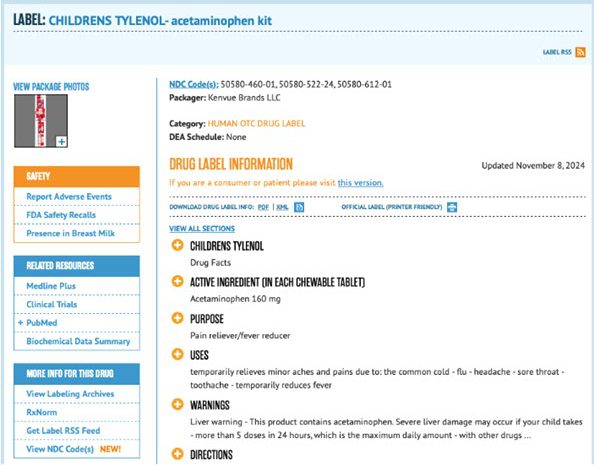
Image 1: Drug label information for Children’s Tylenol- acetaminophen kit. Credit: DailyMed.
DailyMed serves a vital purpose by providing drug and product label information access, and essential access to pharmacology and toxicology information. The information in DailyMed is submitted by the product’s manufacturers and reflects the most recent labeling submitted to the FDA. The current labeling information may include strengthened warnings being reviewed by the FDA and other changes. Daily Med generally posts product labeling within 24 hours of receiving them from the FDA, once the marketing date is current or if there is a new version of a label. This resource is targeted primarily at healthcare professionals and consumers interested in the instructions for a specific medication and dosage from a particular manufacturer. The medication labeling has both prescribing information (PI) written for healthcare providers, and FDA-approved patient labeling directed at patients, families, and caregivers. Safety information is provided, including boxed warnings. There are links to report adverse effects, view FDA safety recalls, and access the Drug and Lactation Database, LactMed.
The two versions of the content in DailyMed – one for consumers or patients, and one for healthcare professionals or users from the pharmaceutical industry – both include additional links. The patient version links to MedlinePlus and ClinicalTrials.gov, while the provider version also links to PubMed and a biochemical data summary. The links to PubMed include searches using specific subheadings, such as searching for adverse effects. The links to specific aspects of drug information in PubMed are helpful if the user is looking for additional information and does not have the PubMed field codes readily available. Users can learn more about medications, such as finding a medication without an ingredient that may be an allergen, using the advanced search. There is also a labeling archive, which allows users to retrieve the label information for a given date. DailyMed also provides a link to customer support via the National Library of Medicine Support Center.
Features & Functionality
DailyMed has several options available for accessing content. There is a basic search feature that enables searching by drug name, national drug code (NDC), drug class, or drug set ID. There is also an advanced search option. The advanced search is powerful and enables searching all drugs (human or animal) and searching for criteria in any of the myriad areas present in a product record. For example, searchers can locate products with or without specific ingredients in the product’s active or inactive ingredients.The advanced search supports Boolean operators, quotes, and wildcards. Users can also browse by drug class. The accessibility of the basic search, as well as the capabilities of the advanced search, distinguishes DailyMed in providing access to information on products approved or regulated by the FDA.
This database will most likely benefit users looking for very specific information. DailyMed includes a help page with tips and a description of how to use the basic and advanced search features. There is a list of the type of information that can be searched, as well as examples for advanced searches. While the basic and advanced search options in DailyMed allow for a variety of approaches, drug names must match exactly, meaning that spelling errors will not retrieve results. Quite often, searching for a drug will retrieve many results due to variations in manufacturer and dosage. Consumers looking for general information on a drug mentioned by their provider will benefit from overview information found in other sources like MedlinePlus. Additionally, the option to switch between the two versions of content, a provider view and a patient or consumer view, can be hard to notice.
Business Model
DailyMed is a free database that is government funded. Academic and healthcare institutions that need access to information on drugs and other products regulated by the FDA should emphasize DailyMed as a key resource, especially since it is a free and useful tool. No subscription is required, and you cannot create a unique account on DailyMed.
Breakthrough
DailyMed, provided by the National Library of Medicine, is a free and comprehensive drug and product labeling database of outstanding quality that any healthcare or academic institution can showcase. Its greatest strength is the access to free, current “in use” FDA drug labeling, presented in a standardized format. DailyMed can benefit all users, from patients and caregivers to researchers and librarians, pharmacists, and clinicians. Health sciences and hospital librarians will want to be sure to know how to use DailyMed and highlight the resource for their users.

Leave a comment