
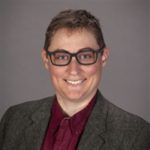
No Comments on LBA Member Profile: Laura Rey, MSLS 1
Laura Rey, MSLS
Instructional Assistant Professor
Texas A&M University
Editor’s note: This month, we are celebrating Laura Rey, who has served as a Doody’s Core Titles Librarian Selector since 2021 and joined the Doody’s Library Board of Advisors in 2026. Thank you, Laura!
Provide a brief description of your library and its services, and your role within it.
My role is quite different because I don’t currently work in a library. I’m an Instructional Assistant Professor in the Department of Small Animal Clinical Sciences in the veterinary school at Texas A&M University. I’m one of two information specialists in the department. Our roles are different from one another. My colleague’s work emphasizes evidence syntheses, and I work some with those, and they’re great. However, my primary role is working with the department in a highly contextual way, teaching a lot of the same information literacy skills librarians in libraries do, but with an emphasis on finding and acquiring information that can carry on after our students leave school and no longer have institutional access to databases and resources. My expertise combines my library science background and evidence-based veterinary medicine methodology. I also work critical thinking skills into a clinical context. Veterinary medicine has less evidence than human medicine and that forces critical thinking skills – if you don’t have evidence you still have to appraise what you have and make a decision because there is a patient, or a herd, to address. Beyond that, I’m a member of the Veterinary Emergency Team, VET. We are the largest veterinary disaster response team in the country. I’ve worked with logistics, safety, and planning, and I teach during a required VET rotation about critical thinking through a virtual exercise simulation. We use Second Life and play different characters designed to elicit various responses.
How did you get started in health sciences librarianship? What brought you to the profession?
I stumbled into it. I was looking for a student job during my undergraduate senior year and I was hired at the university’s veterinary medical library. After I graduated, I worked as a staff member and earned my library degree. I’ve since changed jobs and universities, and I’ve worked in technical services and public services. I was fortunate to discover this field at a critical point in my education and career and have stayed in veterinary medical information because I love working with the subject, the EBVM methodology, and the people. I stay for the people.
Share two of the most important issues facing the profession today and why they’re important to address.
I’ve worked in libraries, and in veterinary information, long enough to have witnessed the loss of subject knowledge as this specialty’s foundational people change positions and retire. Veterinary information as a library specialty is relatively new, and we’re losing collective knowledge. I know this is analogous to other subject areas in academic libraries. Libraries are asked to handle an increasing number of things, likely because librarians are both great organizers and efficient. The number of positions that include a greater variety of subject coverage in addition to other functions for one individual seems to be growing. Time will tell, but it’s concerning because once we lose the foundational knowledge, it’s gone.
Library access, and affordable access to ebooks is incredibly challenging and more complex than it needs to be. Ebooks are a great innovation. They expand the discovery of chapters and have innovative features, but there are issues. When libraries only purchase the ebook version and do not duplicate it in print, this causes an equity issue because some people can’t use the ebook version. Libraries also can’t share ebooks through interlibrary loan, which is another equity issue. I work with disaster planning and if we lose internet, authentication servers, or power, how can we use an ebook during the disaster and recovery? The answer is a continuum of “not easily” to “not at all.” Publishers sell ebooks in packages that sometimes limit access to titles. Sometimes an ebook will only be available in an institution-level package, and sometimes the institution can’t purchase the book because the publisher limits access to individuals. Libraries understand publishers want to develop relationships directly with individuals as students and practitioners, but as we work to solve the textbook cost crisis, this packaging creates unnecessary barriers.
What is one innovation, product, or service in your library that you’re excited about?
I’m excited about tools that make information seeking, acquiring, or synthesizing easier, faster, and more accurate. Currently, I’m really excited that the QUIT Tool – Quality and Uncertainty Indicator Triage tool – was recently published. It helps people evaluate whether an article may be worth their time to read. It’s a topic that kept coming up during discussions with practitioners: “I have limited time. How can I decide what to spend it on?” The Evidence-Based Veterinary Medicine Association (EBVMA) embraced that challenge and created QUIT. It was published in “Introducing QUIT—the Quality and Uncertainty Indicator Triage tool: 10 questions to help veterinary professionals more confidently triage treatment study reports” in the Journal of the American Veterinary Medical Association (JAVMA).
What aspects of your work keep you most professionally motivated?
At the university and in my professional service, I collaborate on practical work, not theoretical work, that improves lives – not only the lives of animals but also the humans who work with and care both about and for them. I’m not sure what could be better than that.
Why do you serve as DCT Librarian Selector and member of the Library Board of Advisors?
I’m a member of the Library Board of Advisors because DCT is positioned to help bridge the gaps among readers, libraries, and publishers. Doody’s is health-focused, yes, but with a recognition that interdisciplinarity is essential. DCT recognizes the importance of including veterinary medicine, One Health, and the medical humanities. The choices we as Selectors make are grounded in a transparent and thoughtful structure that evolves. We recognize DCT resources are critical not only to library budgets but also to people’s knowledge. It’s important to not only make the most responsible financial decision, but also the most responsible information decision, and that can be a delicate balance. I’ve been a Selector for several years and my work on the Library Board of Advisors is new. So far, it has been fascinating and rewarding. I can’t wait to see where it leads.
A recent book you’ve enjoyed or anything else you’d like to share?
I’m currently enjoying Horace Kephart’s Camping and Woodcraft: A Handbook for Vacation Campers and Travelers in the Wilderness. Kephart was a librarian at Yale University and the St. Louis Mercantile Library. When he left librarianship, he moved to the woods and became a fulltime writer and outdoorsman. It’s such a different treatment of the subject because it is about living comfortably and functioning in that environment daily, not just during trips with an end date.

Leave a comment