

No Comments on A Review of CABI One Health Cases 156
Jennifer Brady, EdD, MLIS, AHIP
Head Librarian
Zalk Veterinary Medical Library
University of Missouri
One Health (OH) is the recent naming of centuries-old concepts, shifts, programs, and even movements that have evolved and finally been codified under a single umbrella (Pettan-Brewer et al., 2024). One Health Cases is part of the larger CABI Cases collection, which are educational tools to facilitate inquiry, research, and real-world application. This resource focuses on the multidisciplinary and transdisciplinary nature of a case study between animal and human health, nature and environmental health, and social and anthropological impacts, while exploring the gains and growth opportunities surrounding implementation.
Content
One Health Cases are written by multidisciplinary and transdisciplinary teams to present their topic with One Health impact, emphasizing the educational merit as not all case studies will have a successful outcome. Case reports are peer-reviewed, abstracted, and indexed, giving authors a scholarship opportunity to publish under a variety of models. CABI has been intentional in their transdisciplinary approach, ensuring community stakeholders and decision makers are a part of the conversation while securing best practice and transmutable outcomes. The CABI Cases, including their One Health portion, is part of the content that is included in the Research4Life initiative, providing free online access to peer-reviewed content at academic and professional institutions in lower income countries (Research4Life, 2025).
One Health Cases are applicable for just about anyone interested in tackling problems together to find innovative solutions (One Health Cases – About, 2025). With 87 cases and growing, this resource covers 38 themes and topics such as climate change and its impact on the health of animals, ecosystems, and plants and humans. A One Health case is appropriate for researchers, students, or instructors looking into, for example, how digital innovations and emerging technologies impact urbanization, population migration, housing, sanitation, transportation, pollution of the environment, and socioeconomic status, especially of women and youth. While these cases do not prioritize one theme or topic over another, they do highlight the advantage of utilizing a One Health approach and spotlight pain points and lessons learned. A template is provided for authors wanting to publish to Cases, outlining consistent areas to be discussed in the resource. While authors are not required to use each field, anyone utilizing the CABI Cases resource will potentially have access to learning objectives, a transdisciplinary process, the impact of the project, potential group questions, and further reading options provided within the case. The themes and topics from Cases are cross-identified in the CABI One Health Knowledge Bank and the CABI One Health journal for ease of searchability. To minimize barriers caused by technology deserts, One Health Cases offers the ability to download searches and results to view later.
Features & Functionality
One Health Cases has two search functions: a single search function or the option to use an advanced search function. When utilizing the single search function, the default filters will be applied, which is a limiter set to only search within One Health. After the initial results are returned, available options are to limit by filters (Figure 1, 2025a, Arrow 1), modify search terms (Figure 1, 2025b), or even use the CABI Thesaurus (Figure 1, 2025c) to discover how search terms are related.
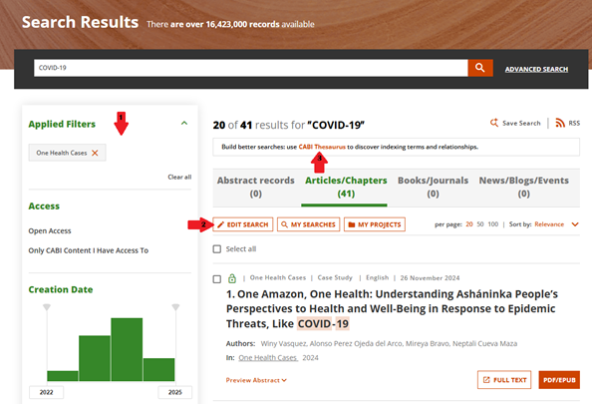
Figure 1: CABI One Health single search results. Red arrows added by author for clarity. Credit: CABI
When conducting an advanced search, limiters can be applied from the beginning, allowing for a more robust search. By building the search through the CABI Thesaurus (Figure 2, 2025) in the advanced search feature, researchers can use indexed terms, much like MeSH terms, to construct a concept-based search.
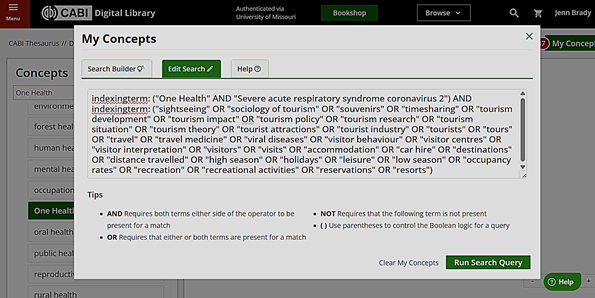
Figure 2: Image of CABI Thesaurus. Credit: CABI
This method of organizing a search generates results closest to a reproducible systematic search. The results from each option can be saved as well as combined with other searches.
Business Model
There are three different models for purchasing One Health Cases. Individual cases for a single user can be purchased for unlimited lifetime use. A personal subscription is available for individual users and grants access to every online case study, including the ability to download PDFs for 12 months. Institutional access grants unlimited users access to all current case studies, the ability to download PDFs, and multiple login methods (e.g., SSO, Shibboleth, Open Athens). Additionally, institutional access allows the organization the ability to obtain archived content as well as lifetime access to case studies published during the contracted subscription period (Plans & Pricing, 2025).
Breakthrough
CABI One Health Cases has a clean, uncluttered interface, making it easy and intuitive for anyone that is familiar with LMS search bars. The case studies are relevant and timely, prompting engaging multidisciplinary and transdisciplinary learning opportunities. Authors often provide learning outcomes as well as group discussion questions and further reading to facilitate continued scholarship pathways. Institutions that have limited resources, especially those with veterinary and medical libraries, might consider One Health Cases as a resource that can serve multiple disciplines while continuing to be fiscally responsible. Librarians serving departments researching aspects of One Health that are unfamiliar with the label — such as in areas like genetically modified organisms, infectious disease, microbiology, Indigenous and local knowledge, or genetics — will benefit from this resource.
References
Figure 1 (Arrow No. 1). (2025a). One Health Cases. https://www.cabidigitallibrary.org/journal/ohcs/about?doi=10.1079%2Fonehealthcases&publicationCode=ohcs
Figure 1 (Arrow No. 2). (2025b). One Health Cases. https://www.cabidigitallibrary.org/journal/ohcs/about?doi=10.1079%2Fonehealthcases&publicationCode=ohcs
Figure 1 (Arrow No. 3). (2025c). One Health Cases. https://www.cabidigitallibrary.org/journal/ohcs/about?doi=10.1079%2Fonehealthcases&publicationCode=ohcs
Figure 2. (2025). One Health Cases. https://www.cabidigitallibrary.org/journal/ohcs/about?doi=10.1079%2Fonehealthcases&publicationCode=ohcs
One Health Cases—About. (2025). One Health Cases. https://www.cabidigitallibrary.org/journal/ohcs/about?doi=10.1079%2Fonehealthcases&publicationCode=ohcs
Pettan-Brewer, C., Penn, G., Biondo, A. W., Jaenisch, T., Grützmacher, K., & Kahn, L. H. (2024). Who coined the term “One Health”? Cooperation amid the siloization. One Health, 18, 100678. https://doi.org/10.1016/j.onehlt.2024.100678
Plans & Pricing. (2025). CABI Digital Library. https://www.cabidigitallibrary.org/journal/ghcs/plans-pricing?doi=10.1079%2Fglobalhealthcases&publicationCode=ghcs
Research4Life. (2025). Research4Life. https://www.research4life.org/

Leave a comment