

No Comments on Review Update: Wiley Current Protocols 64
Abbey Lewis, MSLIS
STEM Engagement Librarian
University of Colorado Boulder
This is an update of the review published in the June 2023 version of Doody’s Collection Development Monthly. You can read the original review here.
Introduction
Wiley’s Current Protocols assists laboratory researchers in the life sciences by ensuring accurate and reproducible results. Over 25,000 protocols cover materials, processes, and proven methods, along with professional topics that assist newer scientists in developing their research careers. The protocols are peer-reviewed by subject-specific editorial board groups and offer essential, thorough guidance. Since the publication of the original review, a steadily growing proportion of Open Access (OA) content makes these crucial resources available to a wider audience.
Content
In 2021, Wiley consolidated all Current Protocols titles, with the past titles serving as sections. Four newly established sections — Multi-omics, Clinical and Diagnostic Methods, Mammalian Systems & Disease Models, and Field-Based Ecology — seem poised to expand offerings to additional research areas. However, a closer inspection reveals that change is mostly in the section structure, rather than disciplinary coverage. Multi-omics contains two protocols, Clinical and Diagnostic Methods has three, and Field-Based Ecology has one. There are substantially more protocols in Mammalian Systems & Disease Models, but this seems to be a new name for the Mouse Biology section without an actual expansion to other mammals. These sections might reflect planning for content that has yet to materialize. The heading text in Clinical and Diagnostic Methods clarifies the difference between the Clinical Methods section and the Diagnostic Protocols sections, although there is no evident way to separate protocols accordingly.
New sections can assist users browsing the site, even if there are only a handful of protocols that can be found in these new sections while content is added. However, a title field search for “multi-omics” found protocols published as recently as February 2026 that were not published to the Multi-omics section, calling into question how reliably this category is used. This inconsistent use of sections makes their function and presence on the website questionable. The site has better ways of directing users to protocols of interest, detailed in the original review.
Throughout the sections, protocols are as well-written and robust as they were when this resource was reviewed in 2023, providing readers with helpful external resources, guiding them through clearly detailed steps that incorporate visual materials, and even furnishing files for documentation or point-of-need reference. The structure and categorization of the sections may benefit from significant redesign, but the content itself remains excellent.
Features/Functionality
The Current Protocols platform is full of useful search and browsing features that are hidden in unexpected places. The Advanced Search can be found through a link that only appears when a cursor is placed in the search box or by clicking on the magnifying glass icon when the search box is empty.
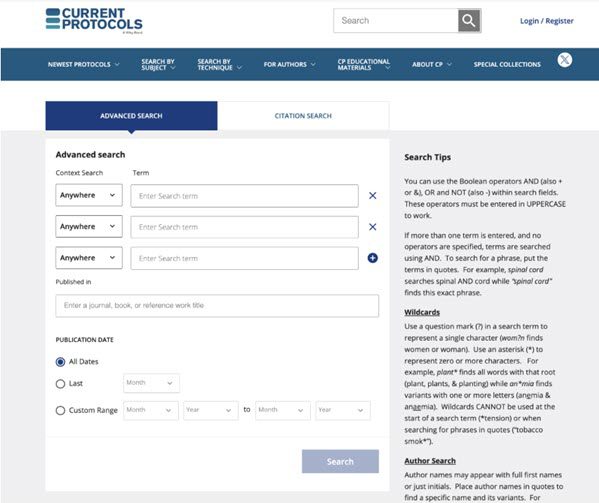
Image 1: The Current Protocols advanced search/citation search page. Credit: Wiley.
Sections can make browsing difficult for users if they attempt to navigate through the list on the resource’s homepage, which provides “most recent” and “most cited” sorting options and a “Browse Articles” dropdown menu that leads to the issue archive. Larger sections have a “Collections” link next to the “Browse Articles” dropdown with curated, subject-specific protocol collections. The drawback is that updates for these collections seem to have stopped in 2023, even for sections that continue to publish new protocols on a frequent basis.
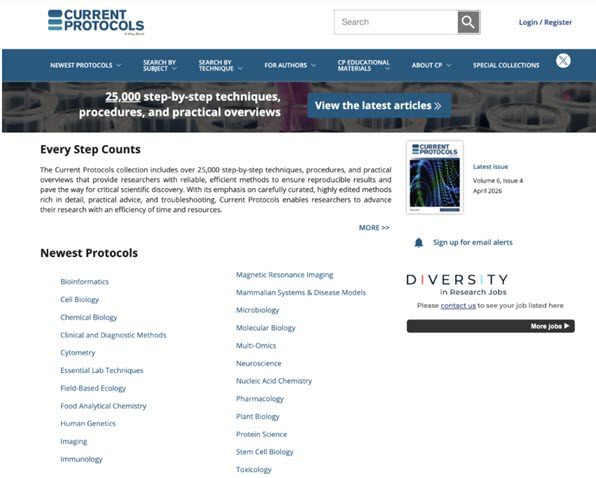
Image 2: The Current Protocols homepage showing a breakdown of the newest protocols by section. Credit: Wiley.
A better browsing option is the “Search by Subject” and “Search by Technique” dropdown menus in the navigation bar at the top of the page. These allow users to drill down through relevant categories by clicking on “+” symbols. Clicking on the name of the category leads to a search results screen listing all protocols found in category. These categories are updated with new protocols and retrieve material from across sections to give more comprehensive results, ensuring that researchers do not miss a relevant protocol. The same subject and technique categories are also available as filters in the regular search results screen.
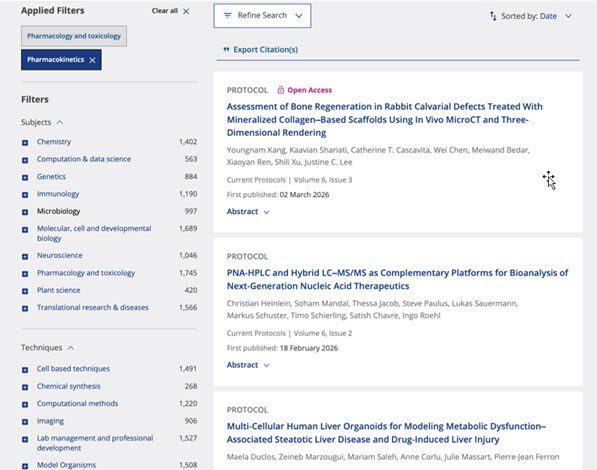
Image 3: A search results page showing subject and technique filter options and the results for Search by Subject > Pharmacology and toxicology > Pharmacokinetics. Credit: Wiley.
The 2023 review noted that content published after the 2021 consolidation to Current Protocols is still being integrated into Special Collections, linked from the top navigation bar on the homepage. This appears to have stalled; only two collections were updated after the review, most recently in 2024. There are still useful collections here, including one curated for members of the Association of Biomolecular Resource Facilities and another that covers “How to Be a Successful Scientist” with protocols for communication, leadership, and research practices. This is a noteworthy feature and adding additional collections that are updated as needed would make Current Protocols even more valuable to users.
Business Model
As noted in the original review, the pricing for a subscription to Current Protocols is dependent on institution size and type. Over the past several years, a hybrid publishing model has increased the availability of Open Access protocols. Although OA Article Processing Charges are currently $5,130 USD, Wiley’s agreements with funders and institutions allow those organizations to pay the fees, smoothing the pathway for researchers. Since 2023, Current Protocols has added close to 400 OA protocols, roughly half of the protocols it published in that period.
Breakthrough
Current Protocols is an excellent resource for institutions with broad life sciences research, offering highly specific protocols for experienced scientists, as well as protocols that can aid students in developing laboratory skills. The confusing sectional structure and links to non-updating collections are a drawback. However, libraries can allow users to bypass that by linking directly to the advanced search page, where the top navigation links to the helpful “Search by Subject” and “Search by Technique” features will still be available. Increasing amounts of high-quality Open Access protocols make this resource worthwhile to promote to researchers, even for institutions that do not hold a subscription.

Leave a comment