
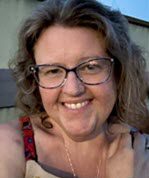
No Comments on DCT Librarian Selector Profile: Anna Hughes, MA, MLIS 152
Anna Hughes, MA, MLIS
Director, Health Sciences Library & Assistant Professor
Marshall University Joan C. Edwards School of Medicine
Provide a brief description of your library and its services.
The Marshall University Joan C. Edwards School of Medicine Health Sciences Library is on the second floor of the medical education part of Cabell Huntington Hospital. It is a shared space with admissions, advising, and faculty development. The main lobby has a wonderfully large skylight that lets light take over, heightens the symphony of raindrops, and is often snowcapped in the winter months. The space has eight group study rooms, most of them including 47” TVs with Airplay capabilities. There are also three single study pods. The students and residents tend to make the spaces their own. I often come into work and discover that the furniture has been switched up. It is very much a living space.
How did you get started in health sciences librarianship? What brought you to the profession?
My B.A. and first M.A. degrees are both in English literature and writing comprehension. I always thought that I would go on to get my PhD and live my life as an English literature professor. That first master’s degree changed my mind. So, I followed in my mother’s footsteps and went to get a second master’s degree in library science. I landed at the University of Pittsburgh’s Information and Library Science fast track master’s program and commuted from Morgantown, WV to Pittsburgh twice a week. During my last trimester, I decided to do an internship. As I was living in Morgantown, I contacted the Dean of Libraries at West Virginia University and asked if there were any internships available. They offered me a choice of either health sciences or law. Health Sciences was the instant winner. The experience was wonderful. I recognized that I could thrive as a health sciences librarian. Two weeks after I graduated, I got a job as the health sciences librarian at the University of Charleston in WV. I stayed in that position for almost 15 years. As of this month, I am now the director of the health sciences library at the Marshall University School of Medicine after serving as health sciences librarian here for three years. I have found that my love of literature and critical analysis has given me a unique way of traversing health sciences research and writing. I have the best of both worlds.
Share two of the most important issues facing the profession today and why they’re important to address.
It must constantly be reiterated that information, and particularly medical information, is the weight librarians carry as we navigate the paths before us. Those paths are thin and rote with numerous challenges from all directions. Misinformation is the monster in our midst. While we recognize and understand the footsteps of our past, the footsteps of our future must be instinctive and quick. It is hardly surprising then that with the onslaught of artificial intelligence (AI), there is the assumption that librarians and libraries will soon be nonexistent. We know this to be untrue. Why? Because librarians are always at the forefront. We adapt, shift, master, create, and recreate both physically and virtually, and pivot (Thank you, Ross Geller). We are the Virgils, the Gandalfs, the Barbara Gordons, the Ranganathans, the Nancy Pearls, and the Yodas. Walking the line, particularly between vetted information and misinformation, will be a constant challenge for our patrons as well as ourselves. But we do have one thing that will forever be true: we have done this all before. Because when you take a closer look, research-based generative AI language models are just the reference interview with a new coat of paint. Librarians’ historical and current understanding and skilled reconfiguration will only work to strengthen the AI Reference Interview with more scholarly pathways and options and hopefully less inherent bias. Librarians must understand that each of us are jacks of all trades as well as heroes with a thousand faces.
What is one innovation, product, or service in your library that you’re excited about?
One of my true loves, aside from my cats, is research, particularly literature searches and search query development. I hold a firm belief that there is nothing stagnant in a medical literature search. Currently, I am in the process of developing detailed, measurable flowcharts for varying research projects, papers, and studies. The medical school has just obtained an institutional subscription to Covidence as part of the system being put into place. Depending on the focus and research or article type, the hope is to formulate a team of medical students, residents, and clinicians from every department to act as an internal peer review team ensuring high standards are met by all poster presentations, case studies, reviews of all kinds, and meta-analyses before they go out into the world for publication or proceedings. Registration of reviews will be required. All literature search queries will be handed over for review to ensure that they are replicable. Risk of bias, quality of data analysis, and adherence to PRISMA guidelines will be monitored.
What aspects of your work keep you most professionally motivated?
The academics. The clinicians. The residents and fellows. And most importantly, the students. I often work late into the night watching the students interact with each other and studying both on their own and in groups. There is a true beauty in the silence of the space. They have their own routines. Being in the midst of it all, I get to be the person they come to with questions. The fact that the library space is shared by all four medical school classes as well as the residents and fellows is a decidedly beautiful way to see each stage of their medical education in action. They notice this as well, which makes it that much more endearing to witness. I have always thought that a library should not only provide different kinds of study spaces for different kinds of learners, but it should also simply be welcoming. I want any library that I create or build to be all-inclusive. Each person who enters is independently distinct. Libraries are meant to be alive and ever evolving. They are beholden to no one other than those who choose to share the space and understand the relationship they form with such an unstoppable force. Libraries inherently let you color outside the lines.
Why have you served as a Librarian Selector for the last eighteen (!) editions of Doody’s Core Titles?
The answer to this particular question is simple, yet very important. I signed on initially as a Librarian Selector for Doody’s Core Titles because I recognized it as a means to learn more about the path my life and actions had put in front of me. The first two years of my career, in all honesty, were ones in which I acted like I knew what everyone was talking about. “Ah yes, the Red Book. Of course! I know what you are talking about.” I spent much of my downtime googling the terms thrown my way simply as a starting point. Then I would move on to the library resources I had access to and would actually learn what I needed to know. Doody’s Core Titles did for me what it was developed to do for everyone else. It was also an excellent way to develop trust in resources and to learn how to negotiate collection development accordingly across differing budgets. I know now that being a Librarian Selector was also a great entry into both book review and peer review criticism and development. I have been a Librarian Selector for about 18 years now, and it is still a resource that helps me as much as it helps others. I was quite thrilled to be one of the first librarian selectors for the new Health Humanities specialty. Once again, I am able to combine my love and interest in literature and the humanities with my love and interest in health care and medical resources.
A recent book you’ve enjoyed or anything else you’d like to share.
I am currently reading for purposeful inspiration, for scholarly pursuits, and for the ability to escape, have some fun, and let my head rest a bit:
Inspiration for a life lived well with purpose: Change the Recipe: Because You Can’t Build a Better World Without Breaking Some Eggs by José Andrés and Richard Wolffe
Scholarly pursuits: A Thesaurus of Medical Word Roots by Horace Gerald Danner
Escapism, fun, and rest: Secrets of a Summer Night by Lisa Kleypas, which stems from the natural move from Bridgerton the TV series to Julia Quinn’s Bridgerton book series to a “if you like these, then we recommend…” Lisa Kleypas’ books.

Leave a comment