

3 Comments on A Review of OpenEvidence 717
LaTeesa N. James, MLIS, MA
Health Sciences Informationist
Taubman Health Sciences Library
University of Michigan
Introduction
OpenEvidence is an AI platform built solely for use by healthcare professionals. As Large Language Models (LLMs) gain widespread adoption for their ability to democratize access to expert-level clinical information, specialized platforms have emerged to meet the rigorous demands of healthcare.1 OpenEvidence was founded by Daniel Nadler and Zachary Ziegler in 2022. In 2023, OpenEvidence launched through the Mayo Clinic Platform Accelerate Program, a highly selective, 30-week program focused on helping health-tech startups validate their AI models using the Clinic’s vast de-identified longitudinal data.2 As an AI-powered clinical decision support platform designed exclusively for healthcare professionals, it has since become a fast, reliable, and credible application for physicians to use at the bedside for various features, including diagnosis support.
Content
The mission of OpenEvidence is to support U.S. physicians with reliable assistance at the point of care. The tool provides a vast repository of verified medical information. Unlike general-purpose LLMs that provide a little bit about everything, OpenEvidence is strictly curated to include high-quality, peer-reviewed clinical content. Clinicians struggle to keep up with the massive explosion of medical research. The platform draws its authority from a foundation of highly respected medical literature. Rather than relying on the open web, the model is built using specialized datasets from premier sources like the National Comprehensive Cancer Network (NCCN) Guidelines, the Journal of the American Medical Association (JAMA), and the New England Journal of Medicine (NEJM).3 This rigorous sourcing ensures that the resulting outputs are grounded in evidence robust enough for professional clinical application.
Content Types
The strength of OpenEvidence lies in its highly curated content library, which avoids the irrelevant content of the open internet. It does this by indexing over 300 medical journals. In my experience, the most impactful aspect for the clinical community at Michigan is the platform’s deep integration with prestigious networks like the New England Journal of Medicine, the JAMA Network, and the Cochrane Library. Because the tool provides full-text access and licensed visual data — including figures and tables directly from original studies — it can serve as a primary source for evidence-based answers rather than a mere summary.
The platform further distinguishes itself by blending current research with authoritative protocols. It integrates clinical guidelines from major medical societies, such as the NCCN, alongside real-time regulatory data from the FDA and CDC. This means users can pivot quickly from checking a drug’s latest safety warning to reviewing the foundational context provided by major textbooks, such as Holland-Frei Cancer Medicine, 10th Edition, Bast et al. (Wiley, 2023) or Rook’s Textbook of Dermatology, 10th Edition, Barker et al. (Wiley, 2024). By providing peer-reviewed research, public health updates, and classic medical texts in one tool, OpenEvidence acts as a comprehensive knowledge hub that supports both quick bedside checks and deeper clinical inquiries. Beyond the search bar, the interface is built for speed. During a typical clinical encounter, users can pivot from a complex diagnostic query to one of the 200+ built-in clinical calculators without leaving the workflow.
Features/Functionality
By utilizing natural language processing, OpenEvidence replaces tedious keyword-matching with conversational search. I encourage medical students to ask complex questions — for example, inquiring about the efficacy of SGLT2 inhibitors for patients with heart failure with preserved ejection fraction (HFpEF) — as naturally as they would consult a colleague. This intuitive approach drastically reduces search time and improves the overall workflow.4
Citations and Verification
In my work with the clinical community at Michigan, my primary concern with adopting AI in clinical settings is the “black box” way that general LLMs work — meaning the inability to see how a model arrived at a specific conclusion. OpenEvidence effectively solves this by functioning less like an oracle and more like a sophisticated research assistant. The tool provides a “Reasoning Trace,” allowing the user to see the logic the AI used to weigh conflicting studies. By tracking users’ specialties and past searches, the tool helps build a customized database of evidence relevant to their clinical practice. Registered users also can see color-coded indicators (e.g., Level 1 vs. Level 3 evidence) as a grading system to help assess the quality of a recommendation before applying it to a patient.5
Because the platform provides inline citations that link directly to original articles and full-text sources for nearly every sentence, the evidence becomes immediately verifiable for students. As an Informationist, I find that my role shifts when teaching this tool; I am no longer just showing residents how to find an answer but rather teaching them how to verify the source of that answer in real-time. This transparency transforms the search process into a collaborative exercise in evidence-based medicine, ensuring that clinical decisions are rooted in peer-reviewed reality rather than algorithmic probability.

Image 1: To access embedded citations, simply click or hover over a reference to view the specific source of the evidence. Credit: OpenEvidence
Clinical Workflow and the “Visits” Experience
When I open the Visits™ interface with users, they are usually relieved to see what the tool can do in relation to the daily administrative burden they deal with. For the clinical community at Michigan, the most value in the Visits™ feature is found in the templates and dropdowns visible in the interface (see Image 2). This interface allows them to access patient records, write notes, and complete after-visit summaries in one streamlined workflow. A standout capability is the transcription tool. While the AI transcribes a patient encounter, it simultaneously scouts for medical evidence to support the documentation. I often tell users that this feature acts as a bridge between the patient encounter and the final documentation, transforming a tedious administrative task into an evidence-based clinical process.
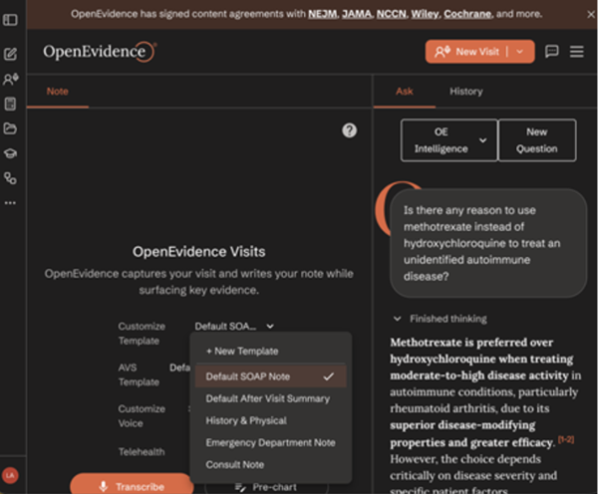
Image 2: This image displays the core functionality of OpenEvidence Visits™, a structured workspace where clinicians can choose a preformatted template (such as an Admission or Discharge Note) to guide the AI’s real-time transcription and data analysis. Credit: OpenEvidence
Advanced Clinical Intelligence Features
- DeepConsult™: For more complex cases, I point experienced clinicians toward DeepConsult™. While the standard search is great for quick facts, DeepConsult™ feels more like a high-level consultation with a specialist. It’s particularly useful when a resident is dealing with comorbid conditions — like managing diabetes in a patient with chronic kidney disease and heart failure — where a simple “yes/no” answer does not exist.
- OpenEvidence 2.0: The latest iteration of the platform has grown beyond a simple search engine to function as a full-scale administrative assistant. It now automates several time-consuming clinical tasks, such as drafting prior authorization requests, creating patient-friendly education materials, and suggesting ICD-10 codes for billing. Additionally, it supports hospital rounds through mobile-optimized modules for discharge planning and order-set suggestions.5
Access/Registration
The primary users of OpenEvidence are physicians, medical residents, medical students, and clinical pharmacists, which is why a NPI is needed to register and gain access to all of its features. I was able to obtain a temporary login for the purposes of this review. If a user is unregistered, they are given restricted access, which means they may only see landing pages, demos, or be prompted to sign up. For security and legal reasons, only verified users can access the above features; they are unavailable to the general public to protect patient privacy.
Compliance and Professional Benefits
As of April 2025, some academic institutions are allowing users to use OpenEvidence as being HIPAA-compliant. Supported by their Business Associate Agreement, this feature ensures that patient privacy is never compromised during the consultation process.6
In December 2025, OpenEvidence launched a HIPAA‑secure Dialer in the iOS and Android apps that allows clinicians to call patients with caller ID set to their hospital or practice number, protecting personal phone details. The Dialer includes unlimited minutes, is free for verified U.S. clinicians, and can optionally create a Visit from the call to auto‑transcribe and generate a quick clinical note with real‑time evidence integration.7
One of the biggest professional advantages for registered U.S. clinicians is the ability to earn AMA PRA Category 1 Credits™ for free.8 Every clinical question asked can be converted into CME credit. After viewing the AI-generated answer and completing a brief assessment, credits are issued to your profile. Practicing residents or clinicians can click on the CME credit option in the menu and can access searches that are eligible for credit and redeem them. Unregistered users do not have the ability to track or earn credits.
Limitations
Despite its clinical strengths, OpenEvidence presents specific logistical hurdles for academic and health sciences libraries. Currently, there is a lack of transparent information regarding institutional costs or site-licensing models for libraries. This lack of transparency makes it difficult for informationists to officially “subscribe” to or vet the tool through standard purchasing processes. Furthermore, the registration process is heavily restricted to NPI-verified clinicians, creating a barrier for educators who need to demonstrate the tool to students. For this review, access was only made possible by coordinating with a internal IT departments to secure a specialized access code specifically for teaching and training purposes. Without a formalized pathway for institutional access, the tool’s utility as a standard teaching resource remains limited by these administrative and authentication constraints.
Beyond these logistical hurdles, there are also functional differences in how the platform retrieves information. While the natural language interface is excellent for clinical questions, it lacks the precision of traditional database searching. For example, I searched for the acronym JMLA to retireve articles from the Journal of the Medical Library Association. This is the answer it produced: “JMML most commonly refers to Juvenile Myelomonocytic Leukemia, a rare and aggressive pediatric myelodysplastic/myeloproliferative neoplasm.” I experienced a similar issue regarding accuracy when searching for a specific article I collaborated on, “A Scoping Review of Women with Physical Disabilities and Cervical Cancer Screening.” While the tool successfully retrieved the study, it struggled with the metadata; it incorrectly listed my name as “Lauren N. James” rather than LaTeesa N. James.
These instances of variability in performance serve as a vital teaching moment for my users. While the platform is an exceptional companion for synthesizing large amounts of data, OpenEvidence maintains an ongoing necessity for a “human-in-the-loop” to validate AI-generated outputs. This is particularly crucial before applying findings to high-stakes clinical scenarios or diagnostic decision-making. As an informationist, I emphasize that the tool is designed to augment, not replace, the clinician’s expertise and critical appraisal skills.
Finally, OpenEvidence is a platform specifically engineered for medical specialists rather than a lay audience. Some may see this as a limitation for the general population attempting to use it. However, as a tool marketed specifically to healthcare professionals, it assumes a high level of existing medical knowledge and information literacy.
Business Model
With backing from industry leaders like Google Ventures and Kleiner Perkins, OpenEvidence is a sophisticated tool designed for the rigors of medical practice. It recently closed a significant Series D funding round in January 2026 — a stage of financing that signals operational maturity and extreme stability — doubling its valuation to $12 billion. It is also now backed by Thrive Capital and DST Global, with total funding reaching approximately $700 million. As of early 2026, it serves over 20 million clinical consultations per month and is used by over 750,000 verified U.S. physicians.9
OpenEvidence is available at no cost to verified U.S. healthcare professionals, utilizing an ad-supported model rather than a traditional subscription fee. By eliminating financial barriers, the platform has achieved widespread adoption across the medical community.
Breakthrough
OpenEvidence has set a new benchmark for clinical intelligence by becoming the first platform to achieve a perfect score on the United States Medical Licensing Examination (USMLE). What I find most impressive — and what I emphasize to the users at Michigan — is the system’s commitment to evidence-based integrity. It privileges clinical accuracy by withholding answers when reliable evidence is unavailable, effectively eliminating the “hallucinations” common in general-purpose LLMs. OpenEvidence is not just a search tool; it is a specialized clinical partner that prioritizes transparency over probability. It maintains a high-level encryption — a requirement for modern medicine — that never stores private health records. It constantly improves by learning from real doctors’ feedback. In my assessment, its real-world value lies in its selectivity. Unlike general-purpose AI that draws from the unfiltered “open internet,” OpenEvidence is built exclusively on a foundation of trusted, peer-reviewed medical texts.
References
(1). Hsu WK, Chuang HC, Wang YY, et al. Concordance of ChatGPT, Gemini, Claude, and OpenEvidence with the 2024 AAOS guidelines on acute isolated meniscal pathology. Knee. 2026;61:104427. doi:10.1016/j.knee.2026.104427
(2). Report: OpenEvidence Business Breakdown & Founding Story | Contrary Research. Accessed April 5, 2026. https://research.contrary.com/company/openevidence
(3). OpenEvidence AI pricing: A complete 2025 guide. Accessed April 5, 2026. https://www.eesel.ai/blog/openevidence-ai-pricing
(4). OpenEvidence AI pricing: A complete 2025 guide. Accessed April 7, 2026. https://www.eesel.ai/blog/openevidence-ai-pricing
(5). OpenEvidence. March 9, 2026. Accessed April 5, 2026. https://sacra.com/research/openevidence/
(6). Report: OpenEvidence Business Breakdown & Founding Story | Contrary Research. Accessed April 6, 2026. https://research.contrary.com/company/openevidence
(7). OpenEvidence. March 9, 2026. Accessed April 5, 2026. https://sacra.com/research/openevidence/
(8). Report: OpenEvidence Business Breakdown & Founding Story | Contrary Research. Accessed April 6, 2026. https://research.contrary.com/company/openevidence
(9). OpenEvidence revenue, valuation & funding. Accessed April 20, 2026. https://sacra.com/c/openevidence/

3 Comments
Thank you for this review – I particularly like the examples to illustrate limitations. Very helpful!
Thank you, this really added to my understanding of Open Evidence.
Thank you so much for this review! It’s frustrating not to be able to experiment with it myself, so I appreciate you sharing your experience and analysis.